800-937-8398 Call us for a free quote Contact us

How do wasps build their nests?

Spotting a wasp’s nest taking shape under your eaves or in a corner of the garden can raise a lot of questions. What is it actually made from? How did it get that shape so fast? And why does it seem to grow bigger every time you check on it? The answer comes down to some surprisingly skilled teamwork, starting with a single queen and a mouthful of chewed wood.

What materials do wasps use to build a nest?

In this guide, we're focusing on paper nest builders, wasps like yellowjackets, hornets, and paper wasps, since these are the species that most commonly cause issues for homes and businesses. Other wasps, like solitary wasps, build very different types of nests, often out of mud or by burrowing into soil, but they're much less likely to cause the kind of nest problems we're covering here.

Wasp nests are made from wood pulp. Worker wasps gather this material from sources like fence panels, garden furniture, dead tree branches, and even the frames of your home. Once collected, the wood fiber is chewed and mixed with saliva to create a paste. This paper-like material is lightweight but provides a great structure and insulation to protect a growing colony from the weather.
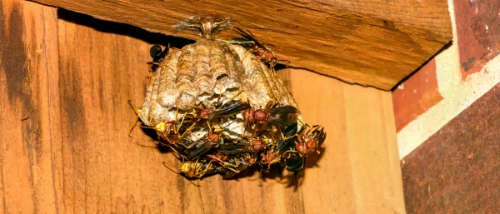
How a wasp nest is made, step by step

Building a nest is a careful, repeatable process. Here's how it comes together:

  1. Gathering material. Worker wasps scrape wood fiber from nearby surfaces using their mandibles (mouthparts), collecting thin layers of raw material.
  2. Making the pulp. They chew the fiber into a paste, mixing it with saliva to create a soft, workable material.
  3. Shaping the cells. The pulp is spread and formed into hexagonal cells, an efficient design that maximizes space while minimizing material use.
  4. Building downward. Layers are added beneath existing cells as the colony grows, extending the nest over time.
  5. Adding the outer shell. An outer covering is built up in overlapping layers, insulating the nest and protecting the colony inside.

Most social wasps, including yellow jackets, hornets, and paper wasps, follow this same basic process. If you'd like to know more about how nest shapes and structures differ between species, our guide to types of wasp nests breaks this down further.

Struggling with wasps?

Call now to book your free inspection.

colony-of-wasps-building-their-nest

How a nest grows from spring to summer

The process starts each spring, when a queen wasp emerges from hibernation and begins building a nest alone. At first, it's just a small, golf ball-sized structure with a few cells to raise her first workers. Once those workers hatch, they take over construction and foraging, and the queen focuses on laying eggs.

From there, the colony can grow quickly. By late August, a mature nest may contain around 20–50 paper wasps, 100–400 bald-faced hornets, 200–400 European hornets, or 1,000–5,000 yellowjackets. Some nests can also reach the size of a football or larger.

If you’ve spotted a wasp’s nest, don’t try to remove it yourself, as this can be very dangerous. Our wasp nest removal experts will handle it for you.


Where wasps tend to build nests

Wasps look for sheltered spots that offer protection from wind and rain while staying close to food sources. Common nesting locations include:

  • Roof eaves and overhangs
  • Attics, sheds, and garages
  • Wall cavities and vents
  • Tree branches and shrubs
  • Fences and garden structures

Checking these areas regularly, especially in spring, can help you catch a new nest while it's still small and easier to manage.

What to do if you spot a nest forming

If you've noticed a nest forming on your property, don't disturb it. Even a small nest can trigger an aggressive response from the wasps defending it, and stings can be a serious concern for anyone with allergies. If you're stung and experience symptoms beyond mild swelling, seek medical attention.

Our wasp control services can help you address a developing nest safely before it becomes a bigger problem.

Frequently asked questions

A queen can build a small starter nest within a few days, but the colony continues expanding throughout spring and summer as more workers join in. Growth tends to slow down again in early fall as the colony's focus shifts away from expansion.

No. Wasp colonies typically only last one season, and nests are rarely reused the following year. Once the colony dies off in late fall or winter, the old nest is usually abandoned for good, so a nest you spot in spring is almost always a brand new one.

Sealing cracks and gaps around your home, securing garbage, and checking sheltered areas in early spring can help make your property less appealing to nest-building wasps. If you find a nest forming, our wasp nest removal team can help you deal with it safely.

Find your local branch

Enjoy protection from 39 of the most common household pests with our annual residential pest control program, PestFree365+.