800-937-8398 Call us for a free quote Contact us

Cicada killer facts and information

Learn about cicada killers - habitat, diet, life cycle, and dangers

The size of cicada killers alone is enough to stop most people in their tracks. But there's more to this wasp than meets the eye. Here's what you need to know.

Quick facts about cicada killers

  • Cicada killers are among the largest wasps in North America, reaching up to 1.5 inches long.
  • Unlike most wasps, they are solitary: each female digs her own individual burrow.
  • Females paralyze cicadas and use them as a food source for their developing larvae.
  • Only females can sting, and they rarely do so unless directly handled or disturbed.
  • Adults are active from June through September, with activity peaking in July and August.
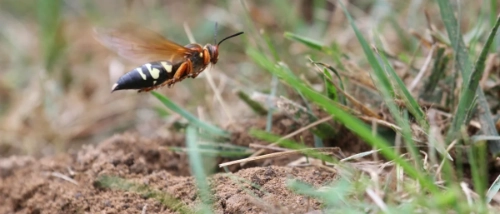
A cicada killer, with orange wings, flies toward a hole in the soil.

What are cicada killers?

Cicada killers are among the largest wasps in the U.S., growing up to 1.5 inches long, with a black and yellow banded abdomen and rusty-orange wings.

Four species exist in the United States, but you’re most likely to encounter the western cicada killer (Sphecius grandis) and the Pacific cicada killer (Sphecius convallis) in the Western U.S.

They're best known for their dramatic hunting behavior: females paralyze cicadas and drag them into underground burrows to feed their young.


Seeing cicada killers?

Call now to book your free inspection.

Habitat, diet, life cycle, and behaviors

Learning how cicada killers behave will be a big help when it comes to spotting them if they’re in or around your yard or business.

Cicada killers prefer loose, well-drained soil in sunny spots. This might include bare patches in lawns, sandy garden beds, or the edges of sidewalks and driveways. Females dig burrows up to 10 inches deep, kicking out mounds of soil as they go. These cicada killer wasp holes are usually about half an inch wide and are often the first sign homeowners notice.

Different species of cicada killers are found across the U.S., with some species, like the eastern cicada killer (Sphecius speciosus), being found in central and eastern states. The western cicada killer is most commonly found in western and southwestern states.

Activity peaks during the hottest weeks of summer. You're most likely to spot them in July and August, when cicadas are also at their most active.
Adult cicada killers feed on nectar and plant sap, and the hunting behavior they're named for is entirely for their offspring. Females sting and paralyze cicadas, then drag them back to their burrows as a food source for their larvae. It's an efficient system, even if it's not exactly pleasant for the cicada.

The life cycle of cicada killers follows a tight seasonal window. Adults emerge in early summer, mate, and females immediately begin digging burrows and stocking them with paralyzed cicadas. Each egg is laid on a cicada, which serves as a living food supply for the developing larva.

By late summer, the larvae have pupated (developed) and will overwinter underground, emerging as adults the following June. The adults you see each summer are a new generation; the previous year's adults don't survive winter.

Male cicada killers are territorial and will hover aggressively around nesting areas, dive-bombing anything that enters their space. While this looks threatening, males have no stinger.

Females are focused on nesting and hunting and will generally ignore people unless handled or stepped on. That said, if you're seeing multiple cicada killer nests in one area, the activity can become disruptive, and the soil damage to lawns can be significant over time.


How to get rid of cicada killers

Cicada killers are largely harmless, but a large population digging up your lawn or garden can be a real nuisance. Getting rid of these stinging insects isn't always straightforward. That's where we come in. Our technicians will assess your property, identify nesting sites, and recommend a targeted wasp control plan to reduce cicada-killer activity and protect your outdoor spaces.


Frequently asked questions

Only females can sting, and they very rarely do. Female cicada killers are focused on nesting and hunting cicadas, not defending territory. A sting is possible if you handle one or accidentally step on one barefoot, so it's worth being cautious.

DIY options like treating burrow entrances with insecticidal dust can offer some short-term relief, but they rarely solve the problem fully. If conditions in your yard remain attractive to nesting females, they’ll continue nesting. For persistent or widespread activity, our professionals can help assess the situation and recommend targeted treatment.

For most people, cicada killers are more of a nuisance than a genuine threat. Their size is alarming, but their temperament is relatively calm compared to social wasps like yellowjackets. The main risks are accidental stings from females and lawn damage from burrowing activity.

Find your local branch

Enjoy protection from 39 of the most common household pests with our annual residential pest control program, PestFree365+.