Temps and termites are on the rise. Schedule your free inspection today.

800-937-8398 Call us for a free quote Contact us

Tarantula hawk facts and information

Learn about tarantula hawks - habitat, diet, life cycle, and dangers

Tarantula hawks are among the most intimidating insects you'll encounter. These large wasps deliver one of the most painful stings in the insect world, yet they're surprisingly docile unless provoked. Understanding their behavior can help you coexist safely with these remarkable creatures.

Quick facts about tarantula hawks

  • Large wasps with black bodies, orange wings, and a powerful sting
  • Females paralyze tarantulas to host their larvae
  • Found in deserts and scrublands across the Americas
  • Docile unless provoked — rarely sting humans unprompted
  • Reduce attractants and seal burrows to deter them


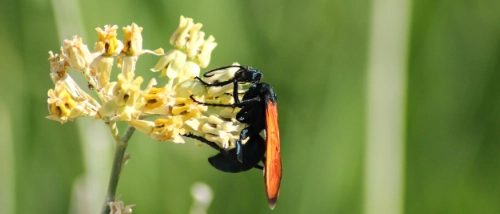
 An adult tarantula hawk, with a dark blue and black body and bright orange wings, clinging to a flower

Tarantula hawk identification

Adult tarantula hawks are large spider wasps, typically about two inches long. In the U.S., the best-known species include Pepsis thisbe and Pepsis grossa, both known for their impressive size. Most species have dark blue or black bodies with bright orange wings that serve as warning coloration—a visual signal to potential predators. Their legs feature sharp spines, and females possess a curved stinger up to seven millimeters long.

Seeing wasps?

Call now to book your free inspection.

Habitat, diet, life cycle, and behaviors

These fascinating parasitoid wasps have evolved remarkable survival strategies that make them not just a formidable species of wasp, but one of nature's most efficient hunters.

Tarantula hawks thrive across South America, Central America, and the southern United States, particularly in the Sonoran Desert and similar arid regions. They prefer areas where tarantulas are abundant, as these spiders are essential to their reproductive cycle. You'll find them in desert landscapes, scrublands, and areas with sandy soil suitable for burrows.

Adult tarantula hawks are nectarivorous, feeding primarily on nectar from flowers like milkweed and soapberry blossoms. Despite their fearsome reputation, mature wasps are gentle pollen feeders. Only the larva stage is carnivorous, feeding exclusively on paralyzed tarantula hosts.

The female tarantula hawk hunts tarantulas to provide food for her offspring. After locating a spider, she delivers a powerful sting that injects venom, permanently paralyzing but not killing her prey.

She then drags the immobilized tarantula to a burrow and lays a single egg on its abdomen. When the egg hatches, the larva burrows into the spider and feeds on it from the inside, carefully avoiding vital organs to keep the tarantula alive as long as possible. Eventually, the larva will pupate inside the host before emerging as an adult wasp. This complete life cycle can take several months.

Male tarantula hawks patrol territories and compete for mating opportunities, while females focus on hunting. These wasps are generally non-aggressive toward humans and will only sting when directly threatened or handled. Their hard, smooth exoskeleton provides protection during encounters with spiders. According to the Natural History Museum, tarantula hawks have virtually no natural predators due to their formidable defenses.

Signs of a tarantula hawk infestation

You'll rarely see large numbers of tarantula hawks since they're solitary. However, frequent sightings of these distinctive wasps near your property, especially around flowering plants or burrows, will confirm their presence. Look for tarantulas acting strangely or paralyzed near their burrows. This is a telltale sign that a female tarantula hawk has been hunting nearby.

Are tarantula hawks harmful?

While tarantula hawk stings are extraordinarily painful, these insects pose minimal danger to humans. Entomologist Justin Schmidt rated the tarantula hawk sting a four on his pain index—the highest level—describing it as "blinding, fierce, and shockingly electric." However, the intense pain typically lasts only five minutes, and the venom causes no lasting damage to vertebrates. The sting serves purely as a defense mechanism, giving the wasp time to escape. These wasps are docile and will avoid confrontation whenever possible.

How to get rid of tarantula hawks

Tarantula hawks are beneficial insects that help control spider populations, but if they're causing concern around your property, there are steps you can take. Avoid swatting or provoking them, as this increases sting risk. Remove flowering plants that attract them near high-traffic areas, and seal potential nesting sites in the ground.

If you’re concerned about wasps on your property, learn more about our wasp pest control services. (We also offer dedicated  commercial pest control services.)

Tarantula hawk prevention tips

Prevention focuses on making your property less attractive to these hunting wasps:

  • Reduce tarantula populations around your property, as they attract tarantula hawks (our pest control professionals can help with this).
  • Limit flowering plants like milkweed near entryways and outdoor living spaces
  • Fill ground holes and burrows that could serve as nesting sites
  • Wear closed-toe shoes when walking in areas where these wasps are common
  • Teach children to observe these insects from a distance without approaching


Frequently asked questions

Female tarantula hawks typically use existing burrows or dig shallow nests in sandy soil. Unlike social wasps, they don't build large communal nests. Each female creates individual nesting sites where she places paralyzed tarantulas with her eggs.

No, tarantula hawk venom is not typically lethal to humans. While the sting is extremely painful, it causes no permanent damage, and the pain subsides within minutes. However, some people may develop allergic reactions. You should seek medical advice immediately if you experience severe allergic reactions.

Tarantula hawks rarely sting humans and only do so when directly threatened or handled. They're remarkably docile despite their fearsome appearance. Most encounters involve the wasp simply flying away to avoid confrontation.

Tarantula hawks are venomous, not poisonous. Their venom is delivered through a sting and is designed to paralyze spiders. For humans, it causes intense but temporary pain without toxic effects.

No, tarantula hawks don't die after stinging. They can sting multiple times if necessary, though they rarely use their stinger except in self-defense or when hunting tarantulas.

Find your local branch

Enjoy protection from 39 of the most common household pests with our annual pest control program, PestFree365+.