Temps and termites are on the rise. Schedule your free inspection today.

800-937-8398 Call us for a free quote Contact us

Mud dauber facts and information

Learn about mud daubers - habitat, diet, life cycle, and dangers

Mud daubers are solitary wasps known for building distinctive mud nests on walls, eaves, and porch ceilings. Unlike social wasps like yellow jackets or paper wasps, mud daubers work alone and are generally non-aggressive. However, their nest construction can become a nuisance, and understanding their behavior helps you know when to call for help.

Quick facts about mud daubers

  • Solitary, non-aggressive wasps that build distinctive mud tube nests
  • There are three common species: black-and-yellow, blue, and organ pipe
  • Females hunt and paralyze spiders to feed larvae
  • They rarely sting; the main concern is unsightly nests attracting other insects
  • Remove active nests professionally, and seal entry points to prevent return


A mud dauber, black and yellow, with a thin abdomen, perched on the ground

Mud dauber identification

Mud daubers are slender wasps with a distinctive thread-like waist connecting the thorax and abdomen. Most species measure between half an inch and one inch long. The black and yellow mud dauber (Sceliphron caementarium) features yellow markings on a black body, while the blue mud dauber (Chalybion californicum) displays a metallic blue sheen. Organ pipe mud daubers (Trypoxylon politum) are entirely black.

All belong to the family Sphecidae, distinguishing them from Vespidae family members like yellow jackets.

Seeing wasps?

Call now to book your free inspection.

Habitat, diet, life cycle, and behaviors

Understanding where mud daubers live, what they eat, and how they develop helps you anticipate and prevent mud dauber activity around your property

Mud daubers build their mud nests in sheltered locations around homes and buildings. Common nest sites include under eaves, on porch ceilings, in garages, sheds, attics, and along exterior walls. The female mud dauber selects protected areas where her mud tubes won't be disturbed by rain or wind.

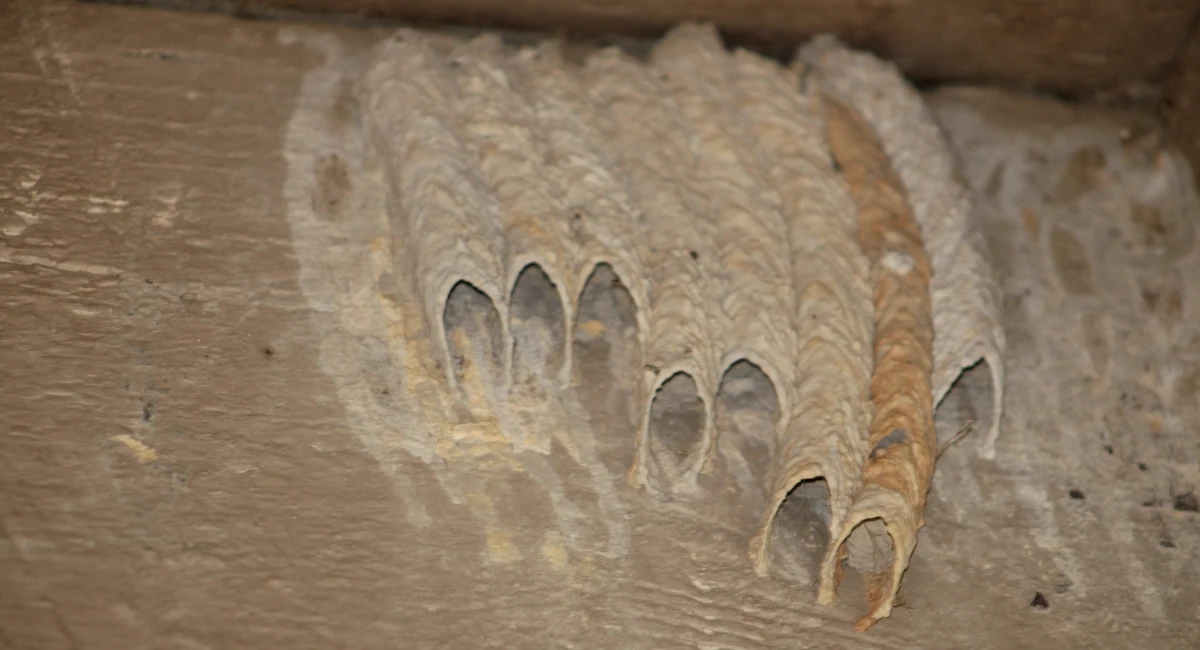
 A mud dauber nest, consisting of long mud tubes

Adult mud daubers feed on nectar and plant fluids, playing a helpful role as pollinators. The female mud dauber, though, hunts spiders. She stings and paralyzes spiders—not killing them—to keep them fresh for her developing larvae. A single nest cell can contain multiple paralyzed spiders. 

The blue mud dauber sometimes steals spider-stocked nests from other wasps rather than hunting for herself. This spider-hunting behavior can help control spider populations around your property, though it shouldn’t be relied upon to control spiders in itself.

Mud daubers undergo complete metamorphosis with four life stages: egg, larva, pupa, and adult. The female mud dauber lays a single egg inside each mud cell after stocking it with paralyzed spiders. The larvae hatch and feed on the spiders for several weeks before spinning a cocoon to pupate. 

Development from egg to adult takes approximately three weeks during warm months. New adults emerge, mate, and the cycle continues. Like many wasp species, mud daubers don't overwinter as colonies—only mated females survive winter in protected locations.

Mud daubers are solitary wasps, meaning each female mud dauber works independently without a colony. She spends considerable time gathering mud, rolling it into balls, and transporting it to her chosen nest site. Nest construction is methodical: she builds cell by cell, provisions each with spiders, lays an egg, then seals it before starting the next. Males don't participate in nest building. 

Mud daubers are generally docile and rarely sting unless directly handled or threatened at the nest entrance. Their calm temperament distinguishes them from aggressive social wasps like yellow jackets.

Signs of a mud dauber infestation

The most obvious sign of mud daubers is a mud nest on exterior walls, under eaves, or on porch ceilings. You may also notice female mud daubers flying back and forth carrying mud balls — a clear sign of active nest building.

Nest structure can help you identify the species: Parallel rows of mud tubes point to the shiny black organ pipe mud dauber, while smooth, rounded cells suggest the black-and-yellow mud dauber. If you're seeing multiple nests or ongoing construction, it's worth calling in professional wasp control.

Are mud daubers harmful?

Mud daubers pose minimal threat to people. They can sting if provoked, but they're not aggressive defenders like paper wasps or yellow jackets. Their venom is mild, and stings are uncommon. That said, a mud dauber sting can be harmful to those allergic to their stings.

The primary concern is the nuisance factor: their mud nests can be unsightly on homes, and abandoned nests may attract other insects. While largely harmless, a mud dauber infestation with multiple nests warrants professional attention from residential or commercial pest control.

How to get rid of mud daubers

Removing mud dauber nests requires caution, even though these wasps are docile. Active nests with adult mud daubers present should be treated by professionals who can safely eliminate the wasp and remove the structure. 

Scraping away mud tubes while mud daubers are active raises the risks of getting stung. Abandoned nests can be carefully scraped off and disposed of, but check that they're truly empty first. Western Exterminator offers expert wasp control to help protect your property from unwanted mud dauber infestations.

Mud dauber prevention tips

Preventing mud daubers focuses on eliminating and blocking attractive nest sites and reducing their food source: spider populations. Taking these preventive steps early can help protect your home from mud dauber activity:

  • Seal entry points – Close cracks and gaps in exterior walls, soffits, and around windows where female mud daubers might build.

  • Treat bare wood – Paint or seal rough wood surfaces, as mud daubers prefer these textures for nest attachment.
  • Remove old nests – Promptly clear abandoned mud nests, since blue mud daubers reuse old structures.
  • Control spider populations – Keep outdoor lights off when possible to reduce the spiders that mud daubers hunt, and consider calling in our spider control professionals.
  • Inspect regularly – Check eaves and porch ceilings often and remove early-stage nest construction.
  • Block access – Install screens over vents and openings to prevent access to attics and crawl spaces.

Professional pest control can discourage mud daubers and other insects from establishing themselves around your home, saving you from dealing with larger infestations later.


Frequently asked questions

Mud dauber nest removal is best handled by a professional. While the wasps are generally non-aggressive, disturbing a nest can provoke defensive behavior. A trained technician can remove the nest and help reduce the chance of mud daubers returning.

Mud daubers are not considered pollinators. Unlike bees, they don't feed on nectar or transfer pollen between flowers. Instead, they hunt spiders to grow their developing larvae.

A female mud dauber can construct a single mud tube in a few hours to a day, depending on conditions and the availability of building materials. A complete nest with multiple tubes may take several days to finish.

Adult mud daubers typically survive a few days to a week without food, though this varies with temperature and humidity. Larvae inside sealed cells can survive longer, relying on the paralyzed spiders stored by the female.

Mud dauber eggs are small, white, and oval-shaped. The female mud dauber lays a single egg on a paralyzed spider inside each mud cell before sealing it. The egg hatches into a larva that feeds on the stored spiders.

Find your local branch

Enjoy protection from 39 of the most common household pests with our annual pest control program, PestFree365+.