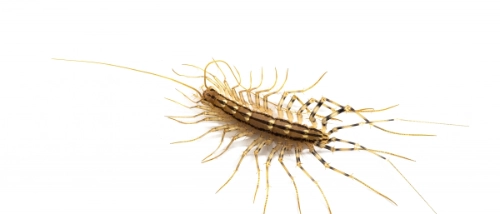
Lots and lots of legs
The first thing you notice is that the house centipede has a lot of legs. The very name “centipede” hints at that since “centi-” means “hundred.” Although it looks like it has a hundred legs, the fact is that the house centipede has 15 pairs of legs. It also has two very long antennae on its head and two long appendages on its rear-end.
Most house centipedes are yellowish-gray and have stripes down the length of their body and across their legs too. Some common centipede characteristics include their elongated bodies, extremely long legs, and rapid, fluid movements. They typically grow to be about 1 to 1.5 inches long, although their legs make them appear much larger. Each time they molt, they grow more legs until they reach their adult form with 15 pairs.
There are several reasons for all of those legs. First, it helps make house centipedes very fast. Since they are both predators and prey, this helps out a lot. They can travel 1.3 feet per second, which means they can usually get away from predators and easily catch up to their intended meal. Second, those appendages, both fore and aft, mean it’s hard to tell which end is the front, which can actually deter predators.