Temps and termites are on the rise. Schedule your free inspection today.

800-937-8398 Call us for a free quote Contact us

Harvest mouse

Learn about harvest mice - habitat, diet, life cycle, and dangers

This guide to the western harvest mouse takes a close look at one of North America's smallest rodents. These tiny mammals rarely cause problems inside buildings, preferring outdoor grassland and hedgerow environments where they build distinctive nests in tall vegetation.

Quick facts about harvest mice

  • Primarily outdoor animals that rarely enter buildings
  • Among the smallest rodents in North America, measuring four to five inches long
  • Brown or grayish-brown fur with grooved front teeth
  • Found in grassy fields, marshes, and areas with dense vegetation
  • They build distinctive ball-shaped nests in tall grasses and shrubs.


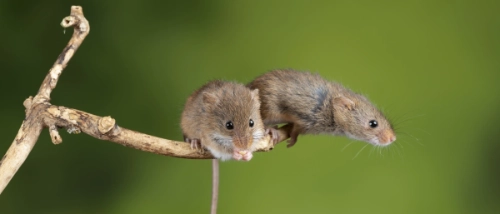
Two harvest mice on a blackberry stem

Harvest mouse identification

Western harvest mice (Reithrodontomys megalotis) are among the smallest rodents in North America. They typically measure four to five inches in total length, with their tail accounting for about half of that measurement. 

Their fur is brown or grayish-brown on their back and sides, with lighter gray or white undersides. One of their most distinctive features is a grooved line running down the center of their upper front teeth, which is visible under close inspection. 

Harvest mice have relatively large ears and eyes for their small head size. Their feet are small and delicate, adapted for climbing through vegetation rather than running on the ground.


Seeing mice?

Call now to book your free inspection.

Habitat, diet, life cycle, and behaviors

From their preference for dense outdoor vegetation to their impressive climbing skills, harvest mice have distinct habits that set them apart.

Western harvest mice are found in grassy fields, meadows, marshes, salt marshes, and areas with dense vegetation. They prefer habitats with tall grasses, weeds, and shrubs where they can build their distinctive nests. They're rarely found inside buildings and prefer natural environments.

Harvest mice are particularly fond of grass seeds, weed seeds, and the seeds of cultivated grains like wheat, oats, and barley. During spring and summer, they also eat green vegetation, including grass shoots and tender plant stems.

Insects supplement their diet, especially during the breeding season when protein requirements increase. They'll consume small beetles, caterpillars, grasshoppers, and other insects they encounter while foraging through vegetation.

In the wild, this is typically six months to one year, though some individuals may survive longer under favorable conditions. A short lifespan is usually due to predation from owls, hawks, snakes, foxes, and other predators.

Female harvest mice reach sexual maturity at about two months old and can produce two to three litters per year. Each litter contains two to six young, with an average of three to four. Breeding typically occurs from spring through fall, with reduced activity during winter months.

Harvest mice are primarily nocturnal but may be active during daylight hours in protected areas. They're excellent climbers, using their semi-prehensile tails and small, agile bodies to navigate through tall grasses and shrubs with ease. They create pathways through vegetation. 

These mice are solitary animals outside of the breeding season and maintain small home ranges, typically less than half an acre. They don't usually enter buildings and prefer to remain in outdoor environments year-round, even during winter. 

If you’re curious about how harvest mice survive in the cold, check out our page: How do mice survive in the winter?

What are the dangers of harvest mice?

This species of mouse poses minimal risk to humans and property compared to others. They're not known to carry or transmit diseases that significantly affect humans, and they rarely enter buildings where they could contaminate food or cause structural damage.

In agricultural settings, large populations of harvest mice may consume grain crops, but the damage is usually minimal compared to that caused by other rodent pests. Their small size and low population densities mean they rarely cause significant economic losses.

The primary concern with harvest mice is potential confusion with more problematic species. Misidentification could lead to unnecessary control efforts or, conversely, to failure to address actual pest problems that require proper strategies for getting rid of mice.

Recognizing the signs of harvest mouse activity

Detecting harvest mice in outdoor environments can help with identification. Some signs include: 

  • Distinctive ball-shaped nests suspended in tall grasses, shrubs, or low bushes
  • Small runways or pathways through dense vegetation
  • Tiny droppings, smaller than house mouse droppings, found near nests or feeding areas
  • Seed caches stored in or near nests
  • Gnaw marks on grass stems and seed heads
  • Sightings of the mice themselves, particularly at dawn or dusk
Two harvest mice on a stem

Where are harvest mice found?

Western harvest mice are found throughout the western United States, from the Great Plains westward to the Pacific Coast. 

Their range extends from southern Canada through the western and central United States into Mexico.

The differences between harvest mice and other mice

Small, often fast-moving rodents can be difficult to identify, but here are a few differences between the harvest mouse and other species.

Deer mice

Deer mice are larger than harvest mice with distinctive bi-colored tails and sharp color contrast between their backs and white undersides. 

Deer mice lack grooved front teeth and prefer wooded areas, rocky habitats, and buildings rather than grassy fields.


White-footed mice

White-footed mice are larger than harvest mice. They have bi-colored appearance and prefer wooded habitats rather than open grasslands.

House mice

House mice are significantly larger than harvest mice and have uniformly colored tails without the semi-prehensile ability. 

House mice lack the grooved front teeth characteristic of harvest mice and prefer indoor environments rather than grassy outdoor habitats.

Voles

Voles have stockier bodies, much shorter tails, and smaller ears compared to harvest mice. 

While both prefer grassy habitats, voles have blunt noses and create extensive runway systems at ground level, whereas harvest mice climb through vegetation and build elevated nests.


Tips for mouse prevention

While harvest mice rarely venture inside, keeping your property secure helps discourage them and other rodents from moving in. Here are some effective ways to protect your space:

  • Seal potential entry points. Check your building's exterior and close up any gaps or cracks larger than 1/4 inch. Focus on foundation openings, door gaps, and spots where utility pipes enter
  • Eliminate food sources. Keep all food in airtight containers. Avoid leaving pet food out overnight, mop up spills immediately, and ensure trash is kept in bins with tight-fitting lids
  • Manage outdoor vegetation. Since harvest mice love tall grass, keep lawn areas near buildings mowed short. Trim shrubs so they don't touch the walls and clear away dense weeds or ground cover within 20 feet of your structures
  • Remove hiding spots. Clear brush piles, fallen leaves, and debris from around the foundation. Store firewood well away from the house and keep it elevated off the ground
  • Reduce moisture. Fix any leaky taps or drainage problems. Ensuring proper ventilation and a dry environment makes your property much less inviting to mice.
  • Hire a professional pest control company. If you're struggling with identification or need a long-term solution, expert help is the way to go. Whether you need domestic pest experts for your home or commercial pest experts for your business, professional technicians can provide the right support.

Frequently asked questions

No, western harvest mice don't sleep in flowers. They build ball-shaped nests from woven grasses and plant fibers, suspended in tall grasses or shrubs. 

The confusion may stem from European harvest mice, a different species known for climbing flower stems, but even they nest in grass structures rather than flowers themselves

Western harvest mice are not rare and are relatively common throughout their range in the western United States. 

However, they're rarely seen due to their small size, nocturnal habits, and preference for dense vegetation. Their populations can fluctuate based on habitat availability and seasonal conditions, but they're not considered threatened or endangered

Harvest mice are generally considered beneficial or neutral. They play an important role in the ecosystem by dispersing seeds, aerating soil, and serving as prey for owls, hawks, and other predators. 

They rarely cause problems for homeowners since they don't enter buildings, and any agricultural damage is typically minimal compared to other rodent species

Find your local branch

Find out more about Western Exterminator and our services.