© 2026 Rentokil Initial plc and subject to the conditions in the Legal statement
Quick overview
- Wasps are natural pest controllers, hunting insects that damage crops and gardens.
- They pollinate hundreds of plant species, including some that rely on them entirely.
- Wasps play a key role as both predators and prey.
- Despite their value, wasp nests near your property can still pose a real risk.
Ask most people what the purpose of wasps is, and you'll get a pretty consistent answer: they're annoying, they sting, and the world would probably be better off without them. But that’s not the whole picture. While having wasps near your property is annoying and can require professional help, they do quite a lot of unglamorous work.
What do wasps do?
When people think of wasps, they’re probably thinking of the handful of social species: yellowjackets, paper wasps, and hornets. But those species are a fraction of the over 100,000 known wasp species worldwide. The vast majority are solitary, non-aggressive, and largely invisible to us.
What they're all doing, in one way or another, is hunting. Wasp larvae are carnivorous, which means adult wasps spend much of their time tracking down other insects to feed their young. That's where their real value starts to show.
Here's a quick breakdown of some of their useful roles in the ecosystem:
- Predators: They hunt and kill a huge range of insects, including many that damage crops and gardens
- Parasitoids: Many species lay their eggs inside or on other insects; the larvae consume the host as they develop
- Pollinators: Adult wasps feed on nectar and transfer pollen as they move between flowers
- Decomposers: Some species feed on carrion, helping to break down organic matter and recycle nutrients
So before you call in our wasp control technicians, read on to find out more about how wasps help the natural environment.
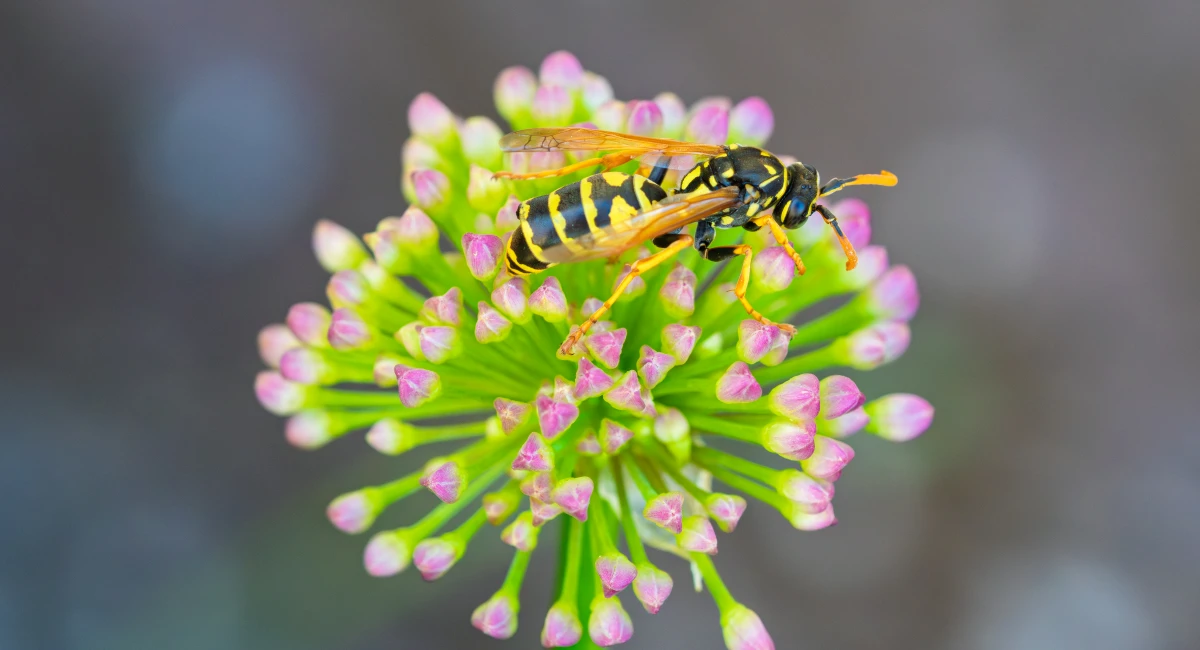
What do wasps do for the environment?
Wasps are useful in gardens and on farms, and they're also more deeply involved in how the wider ecosystems function.
Nature's pest controllers
Wasps are, in the words of University College London biologist Professor Seirian Sumner, "nature's pest controllers." Without them, she argues, "the planet would be pest-ridden to biblical proportions, with much-reduced biodiversity." It's backed by a landmark 2021 review in Biological Reviews that synthesized evidence from over 500 scientific studies on wasp ecosystem services.
Wasps target aphids, caterpillars, whiteflies, and other crop-damaging insects. Solitary species tend to specialize in specific prey, making them particularly useful for managing targeted pest problems. Social wasps are generalist hunters, which makes them valuable as a broad-spectrum, natural form of pest management.
Pollinators in disguise
Bees get all the credit for pollination, but wasps are doing more of this work than most people know. As adults, wasps switch from a protein-heavy diet to carbohydrates, seeking out nectar from flowers. In doing so, they pick up and transfer pollen, making them valuable, if underappreciated, pollinators.
Decomposition and nutrient cycling
Some wasp species feed on animal carcasses, and this contributes to decomposition and the recycling of nutrients back into the soil. It's not glamorous work, but it's essential. Healthy soil depends on organic matter being broken down efficiently, and wasps play a role in that process.
Keeping food webs balanced
Wasps sit in the middle of food webs, meaning they're both predators and prey. Certain bird species, like bee-eaters and honey buzzards, rely on wasps as a food source. Remove wasps from the equation, and you lose both a predator and a food source for the species above them.
When wasps become a problem
None of this means a wasp nest near your front door is something to ignore. Wasps are ecologically valuable, but they're also territorial and will defend their nests aggressively when threatened.
Once wasp colonies stop rearing larvae, workers lose their internal sugar supply and start foraging more aggressively for nectar and sweet foods. This is why they seem to appear from nowhere at outdoor gatherings in August and September.
So while wasps are a valuable part of the ecosystem, they can become pests if they nest too close to you and your family for comfort.
Book your free pest inspection today
Our local technicians will assess your property and recommend tailored solutions. Fast, friendly, and completely obligation-free.
- Safe, targeted treatments
- Local experts, fast response
- Trusted, trained technicians