© 2026 Rentokil Initial plc and subject to the conditions in the Legal statement
Subterranean termites, specifically the western subterranean termite (Reticulitermes hesperus), are notorious for causing significant structural damage before any visible signs appear. They build underground colonies, accessing structures through mud tubes or direct contact with the soil, and feed silently within wood. For commercial properties, this can translate to unbudgeted repair costs, compliance exposure, and operational disruption that property insurance rarely covers. Learn how commercial termite treatment can help protect your business.
.eaa8ff3bedb13363009b6042197a7506.webp)
Understanding subterranean termites in the Western U.S.
Subterranean termites nest underground and depend on continuous soil moisture to survive. Unlike drywood termites that live inside their food source, subterranean species travel from the soil to structural wood via mud tubes made of soil and saliva. Their colonies are organized into three castes: workers, soldiers, and reproductive swarmers.
In the Western U.S., the environment and climate heavily influence termite behavior:
- Arid Regions: In hot, dry climates like California and Arizona, these pests aggressively seek out localized moisture sources, often tracking deep into building foundations. For more localized details, see our guide on Arizona termites.
- Pacific Northwest: Areas with high rainfall and heavy moisture create a highly hospitable environment for prolonged subterranean termite activity. Learn more about the types of termites in the Pacific Northwest.
While the native western subterranean termite is widespread across the West, coastal and port cities also face threats from the invasive Formosan subterranean termite, which forms aggressive colonies numbering in the millions.
What do subterranean termites look like?
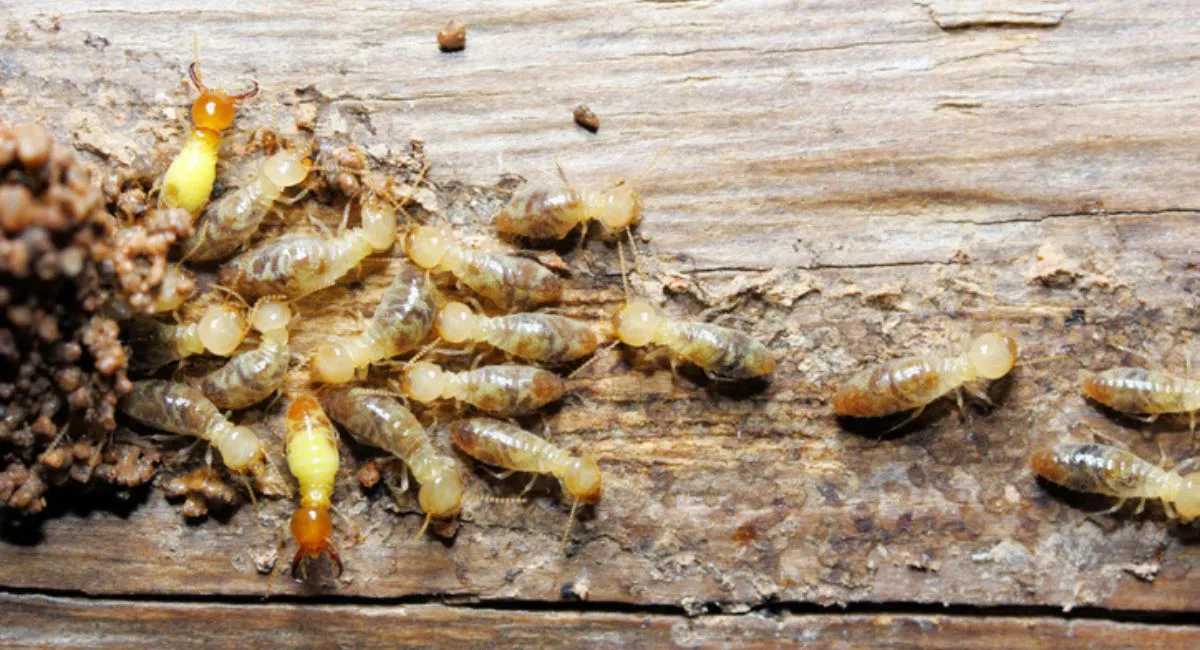
To identify subterranean termites, it is best to focus on the physical appearance of the western subterranean termite castes, as this type of termite is the most common encountered by West Coast businesses.
- Workers: These soft-bodied, wingless insects are cream to pale-white and measure one-eighth to three-eighths of an inch long. They are the primary drivers of structural damage, but are rarely seen exposed to open air or light.
- Soldiers: Similar in size and color to workers, soldiers are distinguished by their enlarged, elongated, rectangular heads and powerful mandibles. They briefly emerge to defend the colony if a mud tube or wood gallery is breached.
- Swarmers (reproductives): Dark brown to black and measuring three-eighths to a half inch long, swarmers possess two pairs of equal-length wings. They are the termites most commonly observed by building occupants. In the Western U.S., swarming typically occurs on warm, sunny days following rain, primarily in spring, though timing can shift depending on local conditions.
Subterranean termites vs. flying ants
Because they share similar nesting timelines and behaviors, termite swarmers and flying ants are routinely confused, but they each have distinct physical characteristics that set them apart.
- Termite swarmers: Feature straight antennae, two pairs of equal-length wings, and a broad waist.
- Flying ants: Possess elbowed (bent) antennae, unequal wing pairs, and a distinctly pinched waist.
Additionally, if you find piles of discarded, uniform wings left behind near windowsills or doors, it is a reliable indicator that termite swarmers were present and have already shed their wings to begin nesting inside the structure.
.226a8aeaa08797d0a8d0be087f241f2c.webp)
Signs your business has a subterranean termite infestation
Detecting an infestation early requires knowing what signs of termites to look for, especially given West Coast architectural standards. For instance, the widespread use of exterior stucco finishes in California and the Southwest often extends below the grade line, creating a hidden pathway for termites to bypass concrete foundations completely unseen.
Keep a close eye out for these key indicators:
- Mud tubes: The most definitive sign. Subterranean termites build these pencil-width mud tunnels to travel between soil and wood. In commercial facilities, look for them along foundation walls, crawl space piers, floor joists, wall studs, mechanical rooms, and utility penetrations.
- Soft wood: Because termites feed from the inside out along the wood grain, they leave a thin outer shell. Structural timbers may crumble when tapped and are likely compromised.
- Buckling paint or bubbling walls: This damage closely resembles water intrusion and is frequently misdiagnosed as a plumbing leak. Termite feeding and the moisture they carry into wall cavities create this bubbling effect.
- Discarded swarmer wings: Found piled near doors, windows, and light fixtures, these indicate a mature colony has reached reproductive capacity.
- Distorted doors and windows: As structural framing shifts due to hidden termite feeding, doors and windows that previously fit perfectly may suddenly begin to bind or stick.
Active mud tubes contain live termites, while inactive ones are dry and brittle. If you break a small section of a tube and return in 24–48 hours to find it rebuilt, the colony is actively foraging. Additionally, the point of discovery is rarely the center of the infestation. Mud tubes observed on an exterior wall or swarmers caught near a window typically mark the endpoint of a feeding trail, while the actual structural damage typically occurs deeper within the building.
What damage can subterranean termites cause businesses?
Subterranean termites feed strictly on cellulose, the structural component of wood. In commercial facilities, they target load-bearing floor joists, wall studs, ceiling joists, and subflooring. Without commercial termite treatment, an infestation can remain undetected for years and lead to a variety of problems.
- Compromised structural integrity: Termites weaken framing and floor systems. In the Western U.S., this poses a compounding hazard: termite-weakened framing can increase a building's vulnerability to severe structural failure during earthquakes.
- Out-of-pocket expenses: Standard commercial property insurance policies strictly exclude termite damage, classifying it as a preventable maintenance issue. Repair costs may come directly out of your facility's operating budget.
- Operational disruption: Visible pest activity can strain tenant relationships, damage guest experiences, and threaten inspection readiness. For regulated industries, such as food processing, healthcare, hospitality, and multi-family housing, documented termite activity can trigger severe audit failures or mandatory facility closures.
How to prevent subterranean termites on commercial properties
Proactive prevention targets the two critical survival needs of subterranean termites: direct access to soil and moisture.
- Maintain at least a six-inch clearance between wood framing and the soil around your entire foundation.
- Remove wood debris, heavy mulch, and cellulose materials from the building perimeter.
- Repair leaking gutters, downspouts, and AC condensate lines that pool moisture near the foundation.
- Seal foundation cracks and gaps surrounding utility penetrations.
- Install and maintain robust vapor barriers in crawl spaces.
- Ensure that sprinkler lines, drip systems, and spray nozzles are directed away from the building and do not saturate the foundation soil.
While these measures reduce overall risk, they cannot eliminate it completely, as foraging workers can travel more than 100 feet from their underground colony. The most reliable long-term protection combines commercial termite treatment with professional monitoring.
Commercial treatment options for subterranean termites
Selecting the right commercial termite treatment depends on your property's construction, the underlying termite species, and activity levels.
In-ground baiting systems
Monitoring stations are strategically installed in the soil around the facility's perimeter. Once termite activity is detected, the stations are loaded with a slow-acting bait that workers carry back to share with the colony. Many states have strict environmental regulations regarding pesticide runoff into waterways, making in-ground baiting systems a preferred solution. They also eliminate the need for disruptive drilling or trenching through finished commercial surfaces.
Liquid treatment (soil treatment)
A professional-grade liquid termiticide is applied to the soil beneath and around the foundation, creating an invisible, undetectable barrier. Termites pass through the zone, contract the active ingredient, and transfer it throughout the colony. This provides immediate protection and is highly effective.
In some instances, a dual approach may be necessary to help eliminate termites.
When should you call a professional for subterranean termites?
If you spot any signs of termites, it’s important to act fast. Subterranean termites, particularly the destructive western subterranean termite, are not a self-resolving issue, and facility-level self-inspections have strict limits. Termite activity deep within wall cavities, underneath concrete slabs, or inside crawl spaces cannot be reliably detected without specialized commercial tools and training.
Western Exterminator experts assess commercial buildings as comprehensive, integrated systems. We review your foundation, crawl spaces, wall cavities, and structural framing to provide the documented treatment and inspection records necessary to satisfy compliance audits and protect your operational continuity.
Frequently asked questions
The rate of damage depends on the colony size, ambient moisture, and species. While native western subterranean termites (Reticulitermes hesperus) feed steadily and can cause notable damage within a few years, invasive Formosan subterranean termites can cause structural damage at a significantly accelerated rate due to their massive colony populations. The primary concern for businesses is the detection lag: infestations can go unnoticed for several years, leading to extensive, costly repairs down the line.
Subterranean termites nest in the soil, require constant moisture, travel via mud tubes, and leave a honeycomb pattern as they eat along the wood grain. Alternatively, the western drywood termite nests directly inside the dry wood structures they infest (such as attics, window frames, and structural timbers) without requiring soil contact. Subterranean infestations typically forage across a much wider area of a building, whereas drywood infestations are smaller and more localized. Consequently, subterranean termites require soil barriers or baiting, while drywood termites are treated via localized spot treatments or structural fumigation.
Yes, subterranean termites are active in every state except Alaska. However, coastal California and the Southwestern states are among the highest-risk regions for commercial properties due to favorable climate conditions that support year-round foraging.
A reliable field indicator is to inspect a mud tube: break off a small section and check it in 24 to 48 hours. If it has been sealed or rebuilt, the colony is actively foraging. Finding live insects inside disturbed wood galleries or finding fresh swarmer wings also confirms an active presence. A definitive confirmation requires a professional commercial inspection to accurately map the extent of the infestation.
Standard commercial property insurance policies typically exclude termite damage, treating it as a preventable maintenance issue. All structural repair costs must be paid directly out of operating budgets. For businesses managing multi-site property portfolios, this financial risk can compound quickly, making proactive termite management a necessary operational line item.
Schedule your free pest inspection today
Get peace of mind knowing your home or business is protected. A Western Extermiantor specialist will assess your property and recommend customized solutions.
Book your free pest inspection today
Our local technicians will assess your property and recommend tailored solutions. Fast, friendly, and completely obligation-free.
- Targeted treatments applied safely and responsibly
- Local experts, fast response
- Trusted, trained technicians