© 2026 Rentokil Initial plc and subject to the conditions in the Legal statement
Quick overview
- Female mice can produce five to ten litters a year.
- Norway rats breed nearly as often, with six to twelve pups per litter.
- Indoor environments let rodents breed year-round, no matter the season.
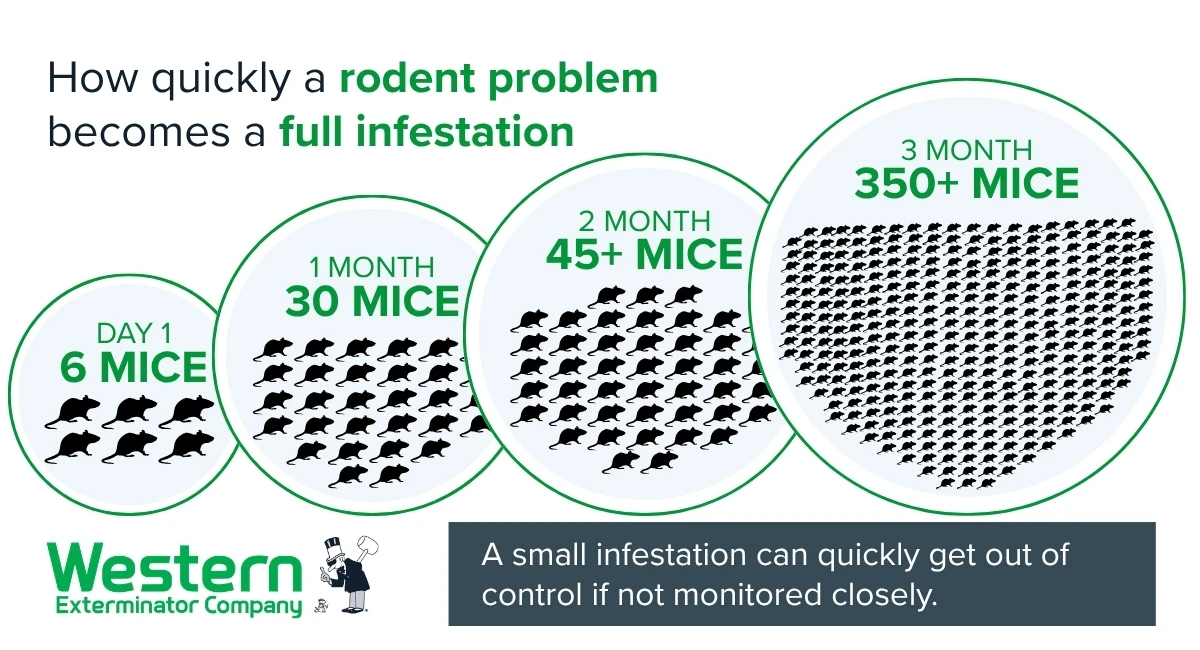
- A small mouse population can grow to dozens within about three months.
- Early detection and monitoring are the best defense against rapid breeding.
Rodents don't need much to get started. A gap around a loading dock door or a warm corner in a stockroom can be enough for a small population to take hold. A good rodent control service should be built around finding specific pressure and entry points in and around your facility before numbers climb.
Understanding the math behind rodent growth
Rodent populations grow through compounding, not simple addition. Each generation starts breeding while the previous one is still producing litters, so numbers build on top of each other rather than in a straight line. That's what makes the breeding rate of mice and rats so hard to keep up with once it gets moving.
Mouse reproduction rates
House mice reach sexual maturity in as little as four to six weeks. After that, a female's gestation period lasts only 19 to 21 days, and she can have five to six pups per litter. Because females can mate again almost immediately after giving birth, a female mouse may produce five to ten litters a year. That's how fast mice reproduce under favorable conditions, and it explains how fast mice multiply in your facility once they find food, warmth, and shelter.
Rat reproduction rates
Norway rats follow a similar pattern on a slightly larger scale. Gestation lasts about 21 to 23 days, and litters typically include six to twelve pups. A female Norway rat can produce three to seven litters a year. Ask how fast do rats breed, and the honest answer is quickly enough that a single breeding pair can be responsible for thousands of descendants inside a year.
Why rodent infestations seem to happen overnight
Rodents are secretive by nature, which is part of why infestations seem to appear out of nowhere. Mice and rats are most active at night, stay close to walls and clutter, and avoid open spaces. By the time signs of mice or droppings show up in a kitchen or storage area, several generations may already be established behind the scenes. If you spot one rodent, it's likely there are more nearby that you haven't seen yet.
Rodent pressure is now a year-round issue
Outdoors, cold weather can slow rodent breeding. Indoors, heated buildings remove that natural check. Warehouses, restaurants, offices, and multi-unit properties all offer consistent temperatures, food sources, and hiding spots, which means rodents can keep breeding through the winter months instead of pausing. That's a key reason rodent pressure has become less seasonal and more of a year-round concern for commercial properties.
What rapid breeding means for your business
For business owners, rapid rodent breeding isn't just a nuisance. Rodents can chew through wiring, insulation, and packaging, and their droppings can contaminate food prep areas and stored goods. A population that starts small can quickly become a compliance issue during a health inspection or third-party audit. Our commercial pest control programs are designed to catch activity early, before a minor sighting becomes a larger operational risk.
How fast can a rodent population double?
Because females can become pregnant again almost immediately after giving birth, and offspring reach maturity within weeks, a rodent population can effectively double in a matter of weeks under ideal conditions. That overlap between generations is what makes early intervention so important.
Do rodents breed indoors during winter?
Yes. While outdoor rodent activity may slow in colder months, mice and rats that have moved indoors have access to steady warmth and food. This allows breeding to continue through winter, which is one reason rodent activity often increases inside buildings during the colder months.
How many rodents count as an infestation?
There's no fixed number, but a single sighting is usually a signal rather than an isolated event. Given how quickly rodents reproduce, seeing droppings, gnaw marks, or one live rodent is a reasonable cue to schedule an inspection rather than wait and see.
Stop rodent reproduction early with PestConnect
Because rodent breeding moves fast, the biggest advantage a business can have is early awareness. PestConnect is our smart, connected rodent monitoring system, built to flag activity in real time rather than waiting for the next scheduled inspection. Sensors placed around your property send alerts as soon as rodent activity is detected, so our technicians can respond before a small issue has the chance to multiply into a larger one.
For commercial properties where downtime, compliance, or reputation are on the line, that kind of early visibility can make a meaningful difference. If you want to see how continuous monitoring fits into your pest management plan, get in touch with our team to learn more about PestConnect and how it works alongside our broader rodent control services.
Schedule your free pest inspection today
Get peace of mind knowing your home or business is protected. Our technicians will assess your property and recommend customized solutions.
Book your free pest inspection today
Our local technicians will assess your property and recommend tailored solutions. Fast, friendly, and completely obligation-free.
- Safe, targeted treatments
- Local experts, fast response
- Trusted, trained technicians