© 2026 Rentokil Initial plc and subject to the conditions in the Legal statement
Quick overview
- Scheduled visits leave gaps where rodent activity can go unnoticed.
- Connected devices monitor rodent activity around the clock.
- Real-time alerts mean a faster response to new activity.
- Continuous data helps target treatment where it is actually needed.
- Rodent pressure has become a year-round issue for commercial sites.
Commercial pest control has long relied on one model: a technician visits on a set schedule, checks traps and bait stations, and moves on to the next stop. That approach has worked for decades, but rodents do not wait for the next appointment. Understanding the difference between traditional and modern methods of pest control can help facility managers decide which approach fits how their building actually operates.
The traditional pest control approach
Traditional pest control methods center on a fixed inspection cycle. A technician arrives on a set date, checks traps and rodent monitoring stations, records what they find, and treats any activity discovered during that single visit.
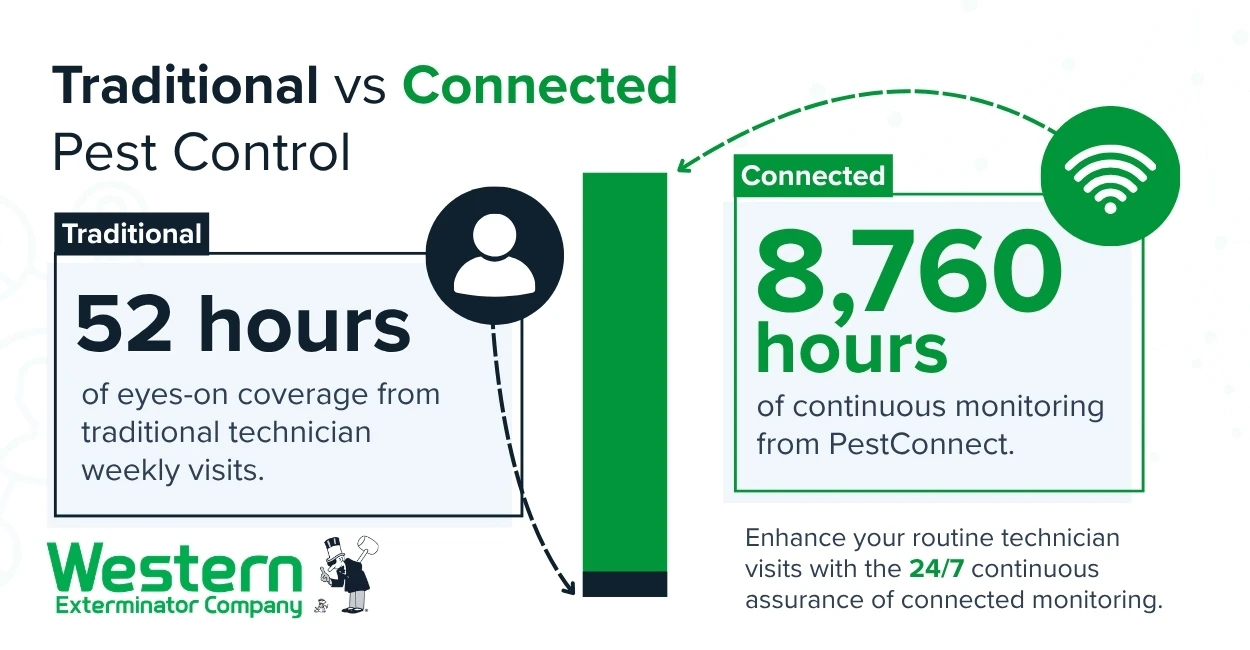
This model has served commercial properties well for a long time, and a skilled technician can catch plenty during a thorough walkthrough. The limitation is timing. Between visits, no one is watching the property. If a mouse or rat moves in the day after a service call, that activity can go undetected until the next scheduled stop, sometimes weeks away. Given how quickly rodents breed, that gap gives a small issue room to grow into a larger one.
Reactive vs proactive pest management often comes down to this exact issue: a traditional program reacts to what a technician can see on the day of the visit, not to what happened in the days before or after.
The connected pest control approach
Connected, or modern, pest control methods add technology to the equation. Instead of relying only on periodic checks, sensors and devices placed around a facility track rodent activity continuously, feeding information back long before the next scheduled visit.
24/7 monitoring and real-time alerts
Connected devices detect rodent activity in traps and exterior bait stations around the clock. When a device is triggered, it sends an alert to the local Western Exterminator team, who can plan a response instead of waiting for the calendar to catch up. That shift from a fixed schedule to proactive pest management is the core difference between the two models.
Smarter data for better decision-making
Because activity gets logged automatically, facility managers gain a clearer picture of what is happening across a site over time. Patterns that would be easy to miss during a single walkthrough, like activity clustering near a specific loading dock or storage area, become visible in the data. For facilities in food and beverage, healthcare, and hospitality, that ongoing record also supports audit and compliance documentation.
Side-by-side comparison
Placed next to each other, the practical differences between the two models come down to a few key areas:
- Coverage: scheduled checks compared with continuous monitoring.
- Response time: waiting for the next visit compared with a real-time alert.
- Approach: reacting to visible signs compared with acting on live activity data.
- Documentation: manual notes compared with an ongoing digital activity record.
That last point matters more than it might seem. Rodent-borne contamination remains a leading cause of food safety violations investigated by public health agencies, according to the Centers for Disease Control and Prevention. For businesses that operate under health code inspections, having a documented, time-stamped record of rodent monitoring can make a real difference during an audit.
Which model is right for your facility?
Connected monitoring is not about replacing a skilled technician. It is about giving that technician better information to work with, no matter the condition of a site. For facilities already dealing with consistent rodent pressure, continuous data helps a technician focus effort where it counts instead of spreading attention evenly across a whole property. For sites where rodent activity is already under control, ongoing monitoring provides a layer of assurance that new activity will not go unnoticed between visits.
For any commercial property where a rodent sighting could mean a failed inspection, a production slowdown, or a hit to reputation, closing the gap between visits is often the deciding factor.
Experience connected pest management in action with PestConnect
Choosing between traditional and connected pest control comes down to how quickly a business can respond once activity starts. PestConnect is our smart, connected pest monitoring system, built to track rodent activity around the clock and alert our local technicians the moment a device is triggered, so a small issue gets handled before it grows into a bigger one.
If your facility could benefit from continuous rodent monitoring alongside your existing service, reach out to your local Western Exterminator team to talk through how PestConnect could work at your site.
Schedule your free pest inspection today
Get peace of mind knowing your home or business is protected. Our technicians will assess your property and recommend customized solutions.
Book your free pest inspection today
Our local technicians will assess your property and recommend tailored solutions. Fast, friendly, and completely obligation-free.
- Safe, targeted treatments
- Local experts, fast response
- Trusted, trained technicians